Setting up a backyard water slide without ruining the lawn
Footprint plus three feet on every side, level ground, and a wind ceiling you can check by looking at a tree. Also: how to get it dry again, which is the part nobody plans for.
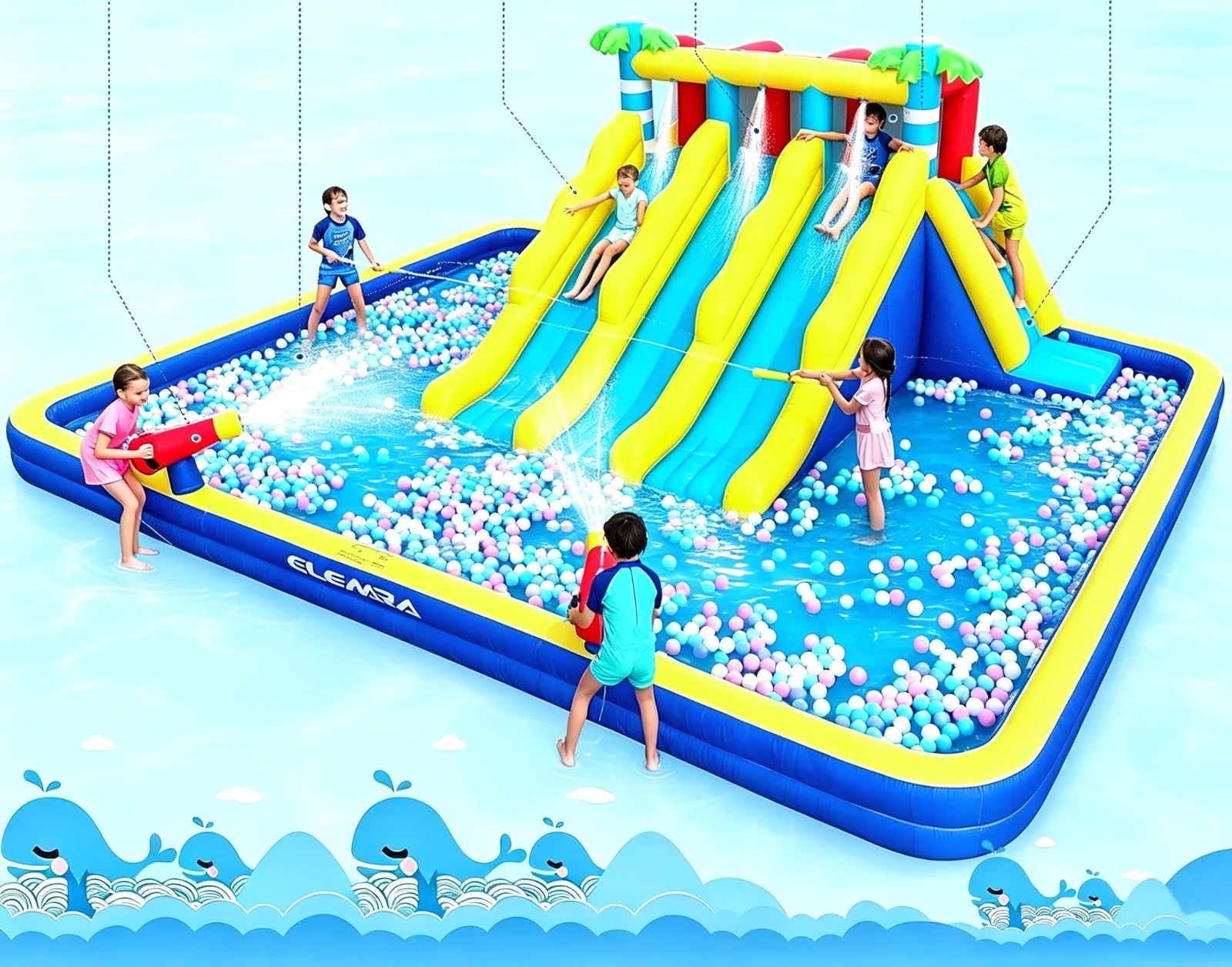
You are standing on the lawn with a folded bundle the size of a rolled sleeping bag, a blower, a bag of stakes and a hammer. The box says the inflated unit measures up to 20.66 by 16.4 feet, which sounds abstract until you pace it out and find it takes most of a modest suburban garden.
The order of the afternoon is the same every time. Mark the ground, clear it, lay the sheet, stake every point, inflate, watch, then drain and dry. The last of those decides whether the unit sees a second summer.
Pace out the rectangle before you unroll anything
The box states the inflated dimensions, but the working footprint is larger. You need about three clear feet on every side: room for the blower's intake, for children entering and exiting, and for the stake lines that keep the unit from lifting in a gust. For our largest parks, that means a rectangle roughly 27 by 23 feet, or the better part of a two-car garage laid flat on your grass.
Walk this perimeter. Look up. The Consumer Product Safety Commission is explicit: no tree branches overhead, no power lines, no fences within the fall zone. The CPSC also asks for flat, even ground, and that is the next measurement, but first confirm you have the horizontal space. A common error is unrolling the unit diagonally across a lawn that is almost large enough, then discovering the corners overhang flower beds or the neighbour's property line.
The unit cannot be repositioned once inflated without deflating it entirely, so this check costs nothing and saves twenty minutes of rework.
Note the terrain. The pool section of a twenty-foot unit will settle where gravity takes it. If your lawn has even a gentle grade, water will accumulate at the low end, submerging one slide's landing zone while leaving the other high and dry. For now, mark your rectangle with garden stakes or lawn furniture, and stand in its centre.
Imagine children running from the climbing wall to the water guns, from the ball pit to the ring-toss game. If the imaginary paths cross concrete edging, a fire pit, or the air conditioning unit, your rectangle is wrong. Adjust it now.
Find the level ground before you commit
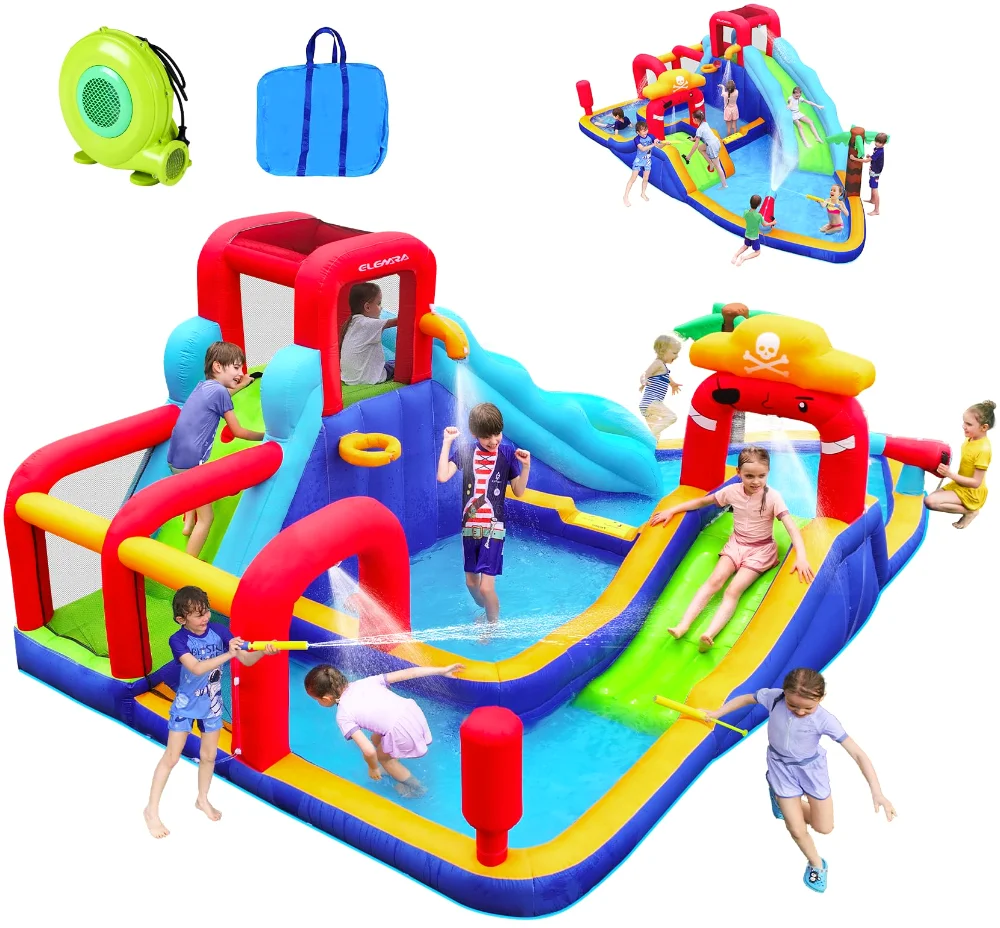
Water finds level. The pool section at the base of our larger units holds several inches when filled, and on a slope that water becomes a wedge, deepest at one end. Children notice. The shallow end becomes a traffic jam; the deep end becomes a place for smaller children to lose their footing. More critically, the unit itself twists slightly under uneven load, stressing seams that were designed for flat distribution.
You do not need a surveyor's transit. A garden hose filled with water makes a serviceable level: hold both ends up, and the water settles to the same height mark on each. Walk your rectangle and note the difference between the high and low corners. If it exceeds six inches over the length of the unit, consider a different location or accept that you will be tipping water out frequently.
Some owners report that the largest units, lacking drain plugs in the pool section, require two adults to lift an edge and dump the water. This is manageable on flat ground. On a slope, it becomes a repeated chore.
Look also for the subtle swales where previous owners or the original grading created low spots. A unit that sits partly in a depression will collect mud underneath, which splashes onto the nylon and grinds into the fabric when children climb. The grass beneath dies in patches. The level check takes five minutes and prevents both of these outcomes.
Walk the ground underneath
Before the groundsheet goes down, walk your rectangle slowly, toe first, feeling for what the grass hides. Sprinkler heads are the most common hazard: plastic caps that shear off under the weight of nylon and children, leaving a geyser that floods the unit and the yard. Stone edging, tree roots, and the concrete footings of old fence posts also wait beneath turf that looks uniform from above.
Remove everything you can. Fill shallow holes with loose soil and tamp them flat. For sprinkler heads that cannot be relocated, mark their positions and plan your unit's placement to avoid them; the stakes you will drive later are steel and can puncture irrigation lines. If your lawn has been treated recently with fertilizer or pesticide, check the manufacturer's guidance for re-entry intervals. Children will be face-down on this surface.
A groundsheet under the unit is a moisture barrier and nothing more. It will not protect the lawn from compression, but it keeps the base from abrading on grit and catches the water that drips off climbing walls and slides, which is what stops the mud underneath from becoming a problem.
Lay it flat, weighted at the corners with the stake bag, before you unroll the unit on top of it. The sequence matters: groundsheet first, then the folded inflatable, then the inflation.
Anchor every point, every time
The blower runs continuously, replacing air that escapes through seams and the weave of the fabric itself. Cut the power, and the unit begins to soften within a minute. This is normal operation for a constant-air device, but it means the structure depends entirely on the blower and on the stakes that keep it from shifting or lifting.
Your box contains two sets of stakes. The water park stakes are longer, with angled heads for guy lines. The blower stakes are shorter, with loops for securing the motor's housing. Use both sets, in every position provided by the manufacturer, even if the afternoon looks calm. The CPSC estimated more than 18,000 bounce-house injuries treated in United States emergency departments in 2018, and reported 12 deaths over 2003 to 2013.
Drive stakes at 45 degrees, pointing away from the unit, so the pull of the guy line seats them deeper rather than levering them out. In hard or compacted soil, pre-drill with a screwdriver to avoid bending the stake heads. The hammer in your box is adequate for normal lawn soil; for clay or rocky ground, you may need a heavier mallet from your garage.
The CPSC guidance on placement bears repeating: no unit near tree branches, power lines, or fences. The field is not the hazard; the fixed objects at its edge are. A child launched from a slide, or a unit lifted by wind, travels toward what surrounds it. Give it space.
Read the wind, and accept indoor afternoons
The CPSC gives a maximum wind speed for bounce house use of 15 to 25 miles per hour. The range reflects uncertainty: manufacturer instructions vary, and local conditions matter. Rather than calibrating your judgment to a number, use the field test the commission recommends: if the tops of the trees are swaying, it is too windy.
This is not conservative advice disguised as caution. A 20-foot nylon sail, even partially deflated, generates lift quickly. Owners have watched units roll across lawns, into streets, into power lines. The stakes you drove are designed for static load, not for a gust that converts the unit into a wing.
Check the forecast before you inflate, and check the trees throughout the afternoon. A still morning can become a breezy afternoon as temperature gradients shift. If you are uncertain, deflate. Packing away costs you the rest of the afternoon and nothing else. Some summer days are for board games, and that is the cost of owning equipment that weighs little and presents a great deal of surface area.
Power the blower safely
The blower in your box draws 450, 750, or 950 watts depending on your unit's size. This is modest consumption, less than a countertop microwave, but it runs for hours in conditions that involve water, children, and extension cords.
Locate your power source before you inflate, and measure the run rather than guessing at it. If the nearest outdoor socket is out of reach, use a weatherproof extension rated for outdoor use, with a ground fault circuit interrupter. Do not run the cord across walkways where it will be tripped over, and do not bury it under the groundsheet where damage will go unseen. The CPSC asks specifically that children be kept away from the blower and from any generator, especially near standing water. Distance and an adult who is watching are what that guidance comes down to.
Position the blower where its intake is not blocked by grass clippings, where its housing will not be kicked, and where its noise does not dominate the yard. The sound is constant and mechanical, not loud enough to damage hearing but loud enough to mask calls for help. An adult stationed near the blower can monitor both the motor's operation and the children at play.
Watch the water with full attention
The Centers for Disease Control and Prevention state that more children aged 1 to 4 die from drowning than from any other cause of death. This includes bathtubs, buckets, and the few inches of water that collect in the pool section of an inflatable park. Drowning happens in seconds and is often silent. The CDC asks that a designated adult watch closely and constantly, without reading, phone, or alcohol.
This guidance is not specific to our products. It applies to any standing water where children play. Our units contain splash pools, but they also contain slides that deposit children into water, water guns that spray and distract, and the general chaos of multiple children of different sizes moving quickly.
The CPSC asks that only children of approximately the same age and size use the unit at once, within the stated occupancy limit, with no tumbling, wrestling, or flips. This reduces collision injuries; it also reduces the likelihood that a smaller child is knocked under water and goes unnoticed.
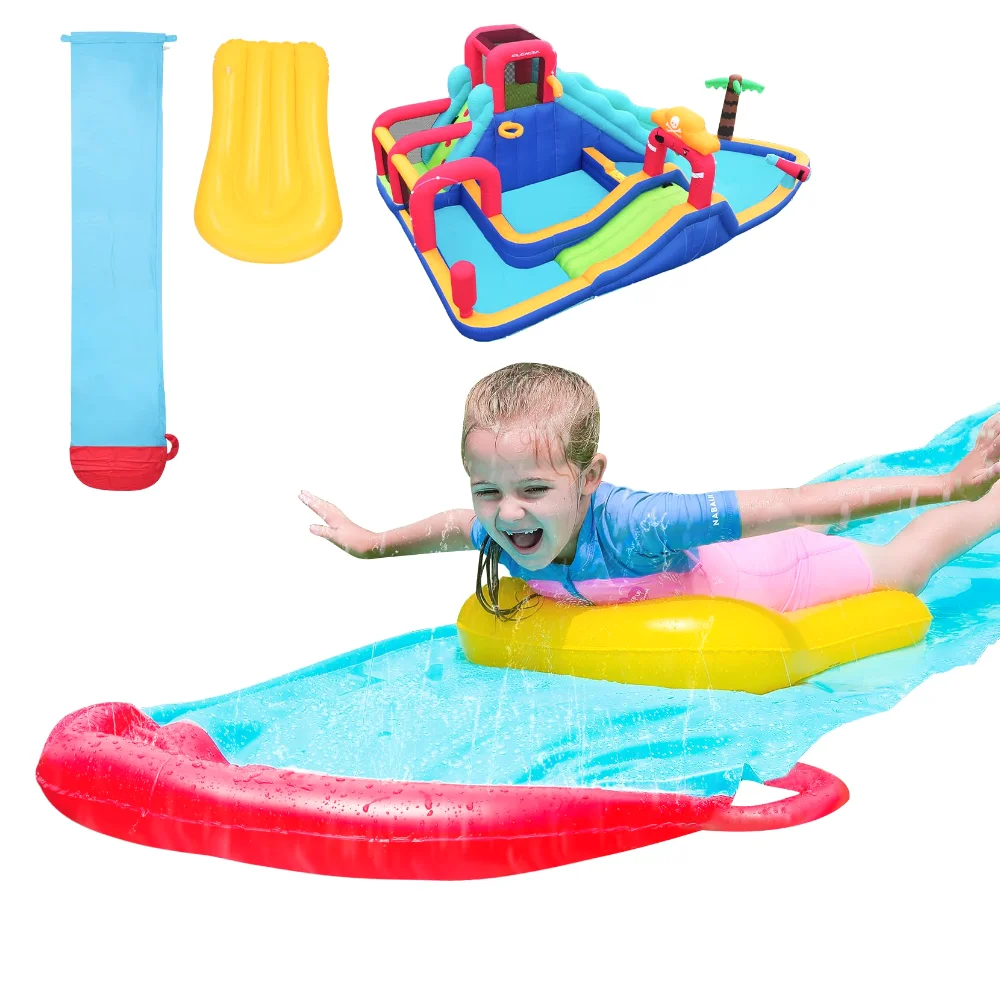
Air-filled or foam toys are not safety devices and should not be relied on as such. The ring-toss game, the bodyboard that comes with the nineteen-foot slip-and-slide, the inflatable columns of the climbing wall: these are play equipment, not flotation. A child who cannot swim needs continuous contact with an adult, regardless of the water depth or the equipment surrounding them.
Drain, dry, and decide the unit's fate
The afternoon ends. Children are towelled off. Now comes the work that determines whether the unit survives to next summer.
First, the water. If your unit has a drain plug in the pool section, remove it and let gravity empty what it can. Many units have no drain plug; the water must be tipped out by lifting an edge. On our largest parks, this requires two adults. Work from the low side of your slope, if you have one, and accept that some water will remain in the seams and folds.
Next, the blower. Keep it running, with the unit inflated but with children excluded. The constant airflow dries the interior surfaces, and it takes longer than anyone expects. Owners report that getting a unit dry again takes longer than putting it up, and that a unit folded away damp grows mould over a winter. Mould is not merely cosmetic: it weakens the fabric, and once it is in the seams it does not come out.
While the blower runs, inspect the groundsheet and the lawn beneath. The grass will be flattened, possibly discoloured, and in hot weather may show signs of heat stress from the groundsheet's greenhouse effect. This is temporary if you act promptly. Remove the groundsheet, move the unit if it is still inflated, and let the grass breathe.
Only when the interior surfaces are dry to the touch do you deflate. Fold methodically, following the creases from the original packing, and roll tightly to expel residual air. The carrying bag in your box is sized for a properly folded unit; if the unit will not fit, you have not folded tightly enough. Store the stakes, hammer, and repair patches with the unit, not loose in a garage where they will be lost.
Give the lawn its afternoon back
The final task is the grass itself. A water slide compresses turf, blocks light, and concentrates foot traffic in a small area. The damage is rarely permanent, but recovery takes management.
Immediately after packing, the lawn will show clear outlines: the rectangle of the groundsheet, the paths where children ran, the depression where the pool sat. Rake lightly to lift the blades. If the weather is hot and dry, water deeply; the grass has been under stress and needs hydration, not merely surface wetting. Avoid fertilizing for a week; the roots have been compressed and cannot take up nutrients efficiently.
In the days that follow, watch for fungal patches where moisture lingered, and for weeds that took the disturbed soil. If you use the slide often, rotate its position to spread the wear, or accept that one part of the lawn will be permanently in recovery. That is the trade for the hours of use you have had.
| Step | What it needs | How long it takes |
|---|---|---|
| Pace and mark the rectangle | Measuring tape or garden hose, temporary markers | Before anything is unrolled |
| Walk and clear the ground | Sprinkler heads, stones, roots, old fence footings | Toe first, the whole rectangle |
| Lay groundsheet and unroll unit | Two people on the large units, flat ground | Sheet first, then the unit |
| Drive all stakes and secure blower | Hammer from the box, a mallet in hard soil, a GFCI extension | Every point, every time |
| Inflate and final checks | Blower runs the whole time it is in use | Under ten minutes |
| Drain and tip water out | Two adults on the large units, a slope or a drain plug | Before the blower goes off |
| Run blower to dry interior | Blower continues, unit stays inflated, no children | Until the seams are dry |
| Deflate, fold, and pack | Tight rolling, the carrying bag from the box | Longer than putting it up |
The field is not the hazard. The fixed objects at its edge are.
More of this sort of thing is in the Garage, and everyone at ELEMARA keeps the whole range one click away on the front page.