Charging, storing and reviving the sealed lead-acid pack in a ride-on
Eight to twelve hours from flat, a top-up every month it is not used, and the one habit that kills more packs than anything a child can do to them.

The box arrived at nine on a Saturday morning. A small rider is already seated, hands on the wheel, and the key produces only silence. The sealed lead-acid pack inside the machine has never been filled, and the care sheet in the box is clear: charge for six to eight hours before the first use, to be sure the pack is full. That means the first drive happens Saturday evening, not before lunch, because patience at this stage is the first maintenance step. The pack is usually 7 amp-hours on our twelve-volt machines and 9 or 10 amp-hours on the twenty-four-volt models, with a standard plug. It lifts out and drops back in without replacing the machine itself.
A full pack gives roughly forty to ninety minutes of driving, though the surface and the rider decide where an afternoon lands in that range. For now, the only task is to plug the charger into a wall socket and let the pack take its first slow drink. The wait is built into the design, as sealed lead-acid chemistry accepts current steadily but not in a rush. Trying to hurry the process with a different charger risks more than it gains, so use the charger that came with the machine, or one that matches the voltage and connector exactly. When the light on the wall plug changes or the hours have passed, the Saturday night drive can begin.
The habit that matters most: charging after the ride, not before the next one
A full pack and a happy driver return to the garage, but the temptation is to close the door and forget it. That decision, repeated often enough, is the single largest factor in how many seasons the pack lasts. The care sheet says to charge for eight to twelve hours after every ride. This is not a suggestion for enthusiastic owners, but the habit that separates a pack that lasts years from one that quits after a season. Lead-acid chemistry self-discharges slowly even when nothing is connected, and it does so faster when the surrounding air is warm. More importantly, a pack that sits partially or fully empty begins to sulfate. The plates inside grow crystals that block the chemical reaction, and a heavily sulfated pack will not take a full charge again. No sentence costs more packs than the casual "we will do it next weekend". By then the pack has settled into a low state, and the damage has started.
The routine is simple, and as soon as the ride ends, the charger goes on. Eight to twelve hours later, or by the next morning, the pack is full and the machine is ready. Leaving it connected for a day longer does not harm sealed lead-acid cells. Forgetting to connect it at all does. Even a pack half full after a short cruise is happier full. The top-off takes the same eight to twelve hours at any level. Our chargers are designed for this nightly rhythm, so they do not need to be unplugged at the exact hour. The wall adapter tapers its output as the pack approaches full, then sits quietly, unable to recover a pack left flat for weeks. That work belongs to a different process, and it often fails.
The sentence that kills more batteries than any charger failure is the casual "we will do it next weekend."
Why a shorter afternoon is usually a surface problem, not a battery problem
Two children take turns on the same machine on the same street, but one returns after ninety minutes and the other is home in forty. The parent with the shorter run assumes the pack is fading, but usually the yard is the variable. A full pack gives roughly forty to ninety minutes of driving. The surface and the rider decide where a machine lands in that range. Grass and a slope cost far more than speed does. A quad or tractor with twin motors running up to 400 watts combined, climbing a lawn, draws harder than a 35-watt single-seat cruiser on smooth concrete. The pack empties sooner because the work is greater, not because it has lost capacity. Cold weather plays a role too, because a winter afternoon reduces the capacity a healthy pack can deliver on that day without permanently harming it. The chemistry is simply less energetic in low temperatures, though the pack will recover its full summer range once it warms.
Some machines give a low-battery voice prompt before they stop. If that warning comes at the expected time on pavement but much sooner on grass, the diagnosis is terrain. Charging habits do not change the physics of the backyard. Heavier riders add load, and twin motors on our larger quads and tractors pull together so that 400 watts empties the same reserve faster than a 35-watt motor on a flat driveway. The difference between forty and ninety minutes is not a defect, but the specification working as designed. Checking run time on asphalt first, then grass, gives a fair baseline. A short afternoon on the lawn that stretches to the full range on the driveway confirms the pack is healthy, as the machine is simply working harder than it looks.
Winter. What to do in October with a machine that will not be used until March
October arrives and the riding season ends, but the machine needs a rest while the pack inside it does not. Before storage, the care sheet says to charge the pack fully, switch the machine off so the battery is disconnected, and store it somewhere cool and ventilated. A switched-off machine breaks the circuit, yet even then lead-acid chemistry self-discharges slowly, and it does so faster when warm. A hot attic is worse than a cool garage. The next step is the one most owners forget, because when the machine is not in use, the care sheet says to charge the pack once a month. The same charger and wall socket handle the eight to twelve hours. This monthly top-up fights the gradual slide toward emptiness. A pack that sits through December and January without help is often sulfated beyond recovery by February. The storage location matters for the machine as well as the battery. A garage corner with a nearby outlet is ideal.
Charger cables rarely reach across a full garage. If the machine parks far from the nearest outlet, plugging in after every ride becomes a chore. Chores become skipped weekends, so a socket within arm's reach of the parking spot removes friction. The charger lives on a shelf nearby, ready to click into the standard connector. Ventilation prevents gas buildup, though sealed lead-acid packs vent far less than older flooded types. Come March, the pack should roll out full and ready, not flat and forgotten. A phone reminder for the first Saturday of each month works better than memory, though the machine does not need to move. The charger plugs into the pack and the wall, and eight to twelve hours later the task is done for another four weeks. This small ritual preserves the pack through the entire off-season, and it costs pennies in electricity while saving the cost of a replacement.
| Situation | What to do | How long it takes |
|---|---|---|
| First use out of the box | Charge the sealed lead-acid pack fully | 6 to 8 hours |
| After every ride | Connect the charger and let the pack fill | 8 to 12 hours |
| Monthly top-up during storage | Charge the switched-off machine | 8 to 12 hours |
| Pack that refuses to charge | Attempt a continuous recovery charge | 48 hours |
| Full pack on a typical afternoon | Expect run time | 40 to 90 minutes |
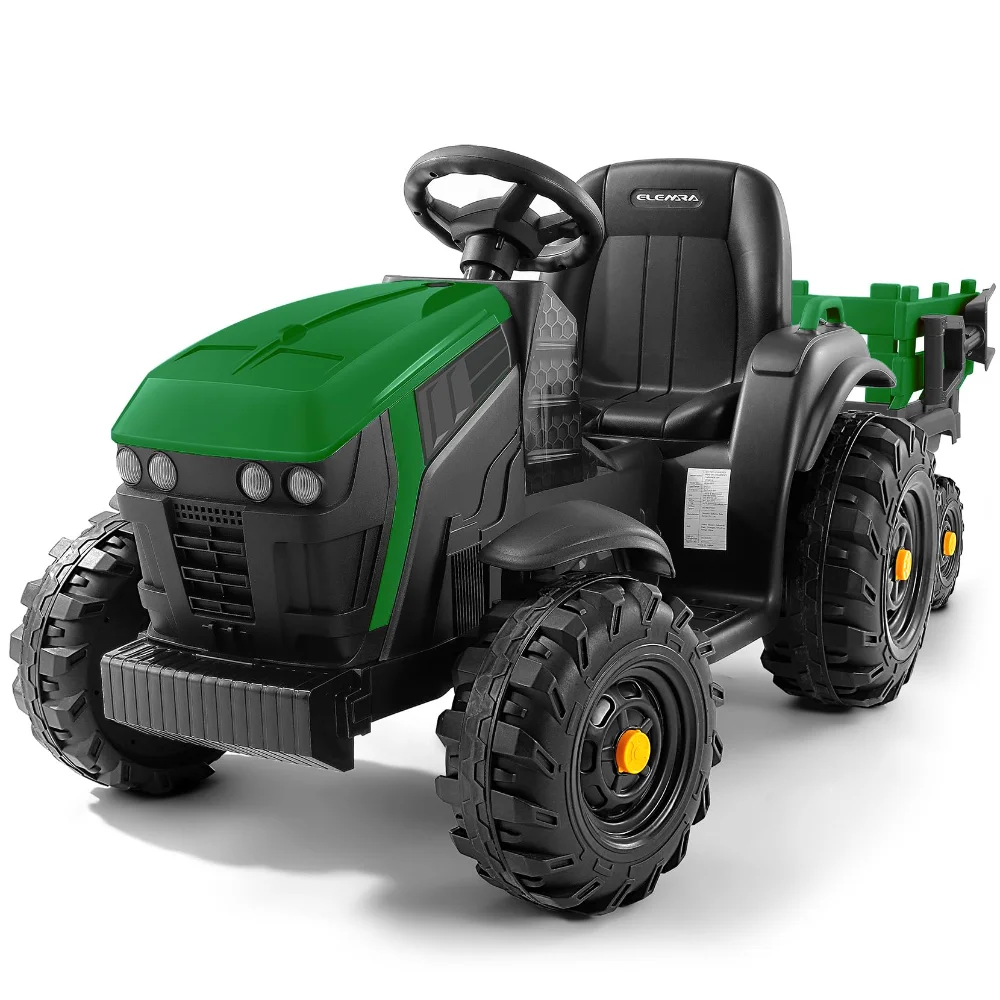
ELEMARA 24V 9AH Ride-On Tractor with Easy Detachable Trailer
24-volt battery · 4.5 mph top speed · Holds 88 lb
$285.99
Where the machine lives, and the socket that needs to reach it
Every ride-on needs a home that respects the machine and the charger, because a damp basement invites corrosion and a sunny porch heats the pack to accelerate self-discharge. The care sheet calls for somewhere cool and ventilated, which is as much about the room as the battery. A garage corner, a shed with a window, or a dry alcove under a carport all serve. The deciding factor is often the wall socket, since charger cables rarely reach across a full garage.
On the twelve machines with a 2.4 GHz parent remote, remember that the remote runs on its own small batteries rather than on the pack, so its range depends on those cells, not on the lead-acid block. Spare remote batteries belong near the charger, and the machine itself needs no special stand. Level ground, a roof or tarp if the storage is open, and enough space to roll the wheels forward occasionally prevent flat spots. The best plan makes charging easier than forgetting.
Diagnosing a machine that will not go: charger first, wiring second, pack last
A spring morning arrives and the machine will not move. The instinct is to blame the battery, yet the pack is usually the last suspect. The care sheet lays out a clear order, so first check or replace the charger. Wall adapters fail more often than the pack, so borrow a known-good charger with the same voltage and connector. If a replacement charger brings the pack back to life, the problem is solved. Second, check the wiring, because the standard connector can work loose or a pin can corrode. Wiggle the plug and inspect for green crust or a cracked housing, then move to the final test if both are good. Try charging continuously for forty-eight hours and test again. This gentle current can break down light sulfation and coax a stubborn pack back to a usable voltage. It is not guaranteed, and if the pack still does not hold after two full days on the charger, the pack is finished.
At that point the diagnosis is complete, and the machine is almost certainly fine. The motors and gears are built to outlast several packs, so a fresh pack drops in and the season resumes. Our twelve-volt machines use a 7 amp-hour pack, and the twenty-four-volt models use 9 or 10 amp-hours, so the replacement charger must match the voltage exactly. A twelve-volt charger will not fill a twenty-four-volt pack, and a twenty-four-volt charger has no business on a twelve-volt one, so check the connector shape first. If the plug does not fit, stop. The wiring harness inside the machine is not user-serviceable beyond the external connector, so do not open the chassis to trace wires. If the connector is clean and tight, the wiring is likely sound, and the forty-eight-hour test will settle the matter.
Replacing a pack: what to check before ordering, and why the machine around it is usually fine
A pack that will no longer hold a charge is a consumable part, not a fault in the machine around it, and this is an important distinction. It means the motors, running from 35 watts on our smallest cars up to 400 watts a pair on the quads and tractors, are healthy. The frame and steering are intact, and only the fuel tank needs renewal. Before ordering, check the old pack or manual for the voltage: twelve or twenty-four. Then check capacity: 7 amp-hours on twelve-volt machines, 9 or 10 on twenty-four-volt ones. Finally, make sure the connector is the standard type used across our range. The pack comes out and goes back without replacing the machine, and a firm pull on the plug is usually enough. New packs arrive with a partial charge, but the care sheet still recommends a full six-to-eight-hour conditioning charge before the first drive, after which the old routine returns.
Charge after every ride for eight to twelve hours. The machine, which may have sat idle for weeks waiting for the diagnosis, suddenly has another season in it. That longevity is by design, because a ride-on is built to outlast several packs. Think of the pack like the tyres on a bicycle: they wear, and swapping them is normal, but the frame remains. The standard that governs machines of this kind, ASTM F963, is about the machine rather than the life of its battery. The battery is expected to degrade, and when it does, the replacement process is straightforward: match the specs, install the block, charge it fully, and the rider is back in motion.

What regular charging cannot fix
There is a limit to what patience and a good charger can undo, because a pack left flat for months develops sulfation on its plates. The crystals harden and insulate the active material, and a heavily sulfated pack will not take a full charge again. Forty-eight hours of gentle current can soften light buildup, but it cannot rebuild a pack that has been deeply discharged. Regular charging cannot fix this, and neither can a more expensive charger. Once the plates are sealed behind that white mineral crust, the chemical surface area is gone, and the pack becomes a resistor that warms rather than stores energy.
This is not a manufacturing defect, but the normal end of life for a consumable part that has been stored incorrectly or neglected too long. The difference is almost always the garage routine, not the factory, so a machine charged after every ride and topped up monthly through the winter will usually outlast a neglected one. One that is left flat each August is unlikely to recover. The good news is that the machine itself is built to survive these cycles, and a fresh pack restores it completely. Replacing the pack is the only fix, so learn the rhythm and the next one will last.
More of this sort of thing is in the Garage, and the people at ELEMARA keeps the whole range one click away on the front page.